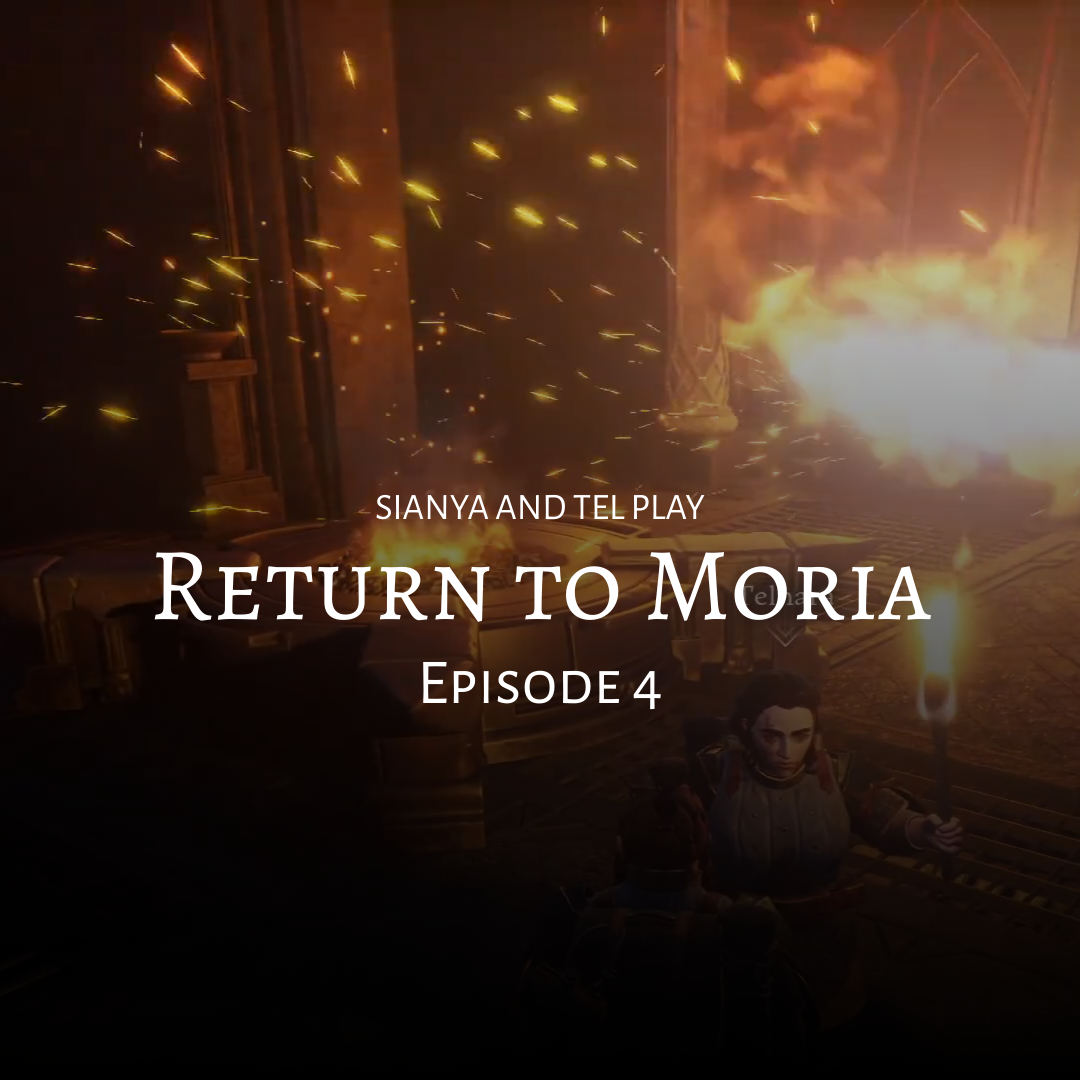
Return to Moria EP4 – The Second Descent: steel swords, spider chaos, Orc Town, and our first truly terrible decision
There are streams where you begin with a clear plan, sharp focus and an organised sense of purpose.
And then there are streams where you begin by taking a sip of coffee, realising you forgot the sweetener, discussing the emotional structure of cozy games, and somehow ending up completely naked in a dwarven death zone because you ignored the person who actually knew what she was doing.
This was one of those.
Episode 4 of The Lord of the Rings: Return to Moria – The Second Descent originally streamed on 12 March 2026, and it gave us quite a lot, really: morning chaos, gaming philosophy, a full sibling-style strategy dispute, our first proper corpse run, a genuinely useful upgrade breakthrough, a trip into Orc Town and finally a boss encounter that very firmly informed us we were not ready.
Not emotionally.
Not tactically.
Not in trousers.
“Good morning… me chaos”
We began at an unusual hour for us.
Not afternoon.
Not evening.
Actual morning.
Which naturally meant the atmosphere was already slightly suspicious.
“Good morning.”
“Good morning. And it is morning today, not afternoon because you know me. Me chaos.”
Before we even made any real progress in Moria, we somehow took a detour into a conversation about cozy games, game loops and why I routinely bounce off titles that are theoretically supposed to be ideal for me.
This is, apparently, because I enjoy collecting, mining, crafting and wandering about beautifully designed spaces… but would also quite like there to be something to hit.
Preferably with a sword.
“There’s nothing for me to kill.”
Which, in fairness, does explain a lot.
We talked about Cozy Grove, Dreamlight Valley, Stardew Valley, Animal Crossing and the strange difference between games designed to be dipped into for half an hour and games I instinctively approach like a woman trying to fully clear a map, empty every chest, gather every herb and accidentally trigger combat in places I absolutely should not.
So, within the first few minutes, we had already established two very important truths.
Firstly, I like progression with a side order of violence.
Secondly, Tel already knew she was going to have to manage me.
The explorer and the foreman
A lot of this episode quietly revolves around our very different approaches to playing Return to Moria.
I like to look everywhere.
I like to check every corner.
I like a tidy sense that an area has been completed properly and that I have not, in fact, missed a useful chest, a mushroom, a resource node, or some secret bit of map geometry with a mildly important object tucked behind it.
Ideally, games would simply tell me this.
“I do like a nice little tick checklist.”
That, according to Tel, is because I am essentially an achievement hunter in a dwarven helmet.
She is not wrong.
“It’s like achievement hunting, right?”
“That’s exactly why I said it. It’s because I know that you’re a fiend.”
Unfortunately for me, Return to Moria is not especially interested in soothing this instinct. It does not hand you a neat little completion menu. It does not congratulate you for thoroughly sweeping an area. It mostly just waits for you to get distracted by a wall, a noise, a mushroom patch or a promising hole in the rock, then punishes you for your optimism.
Which is, I suppose, very Moria.
We were not meant to be doing this
Our original plan for the session was, in theory, sensible.
We were going to stay relatively local, avoid pushing too far into trouble late in the day, gather what we needed, keep an eye out for the missing statues and improve our gear without doing anything overly heroic.
Naturally, this lasted almost no time at all.
There was purple corruption.
There were spiders.
There was one of those moments where you know perfectly well that you are drifting into nonsense, but you keep moving anyway because there might be something useful just ahead.
“We weren’t meant to be doing this, were we?”
“No.”
“It’s okay. It’s all good. A bit of murder.”
That sentence probably sums up the entire stream.
The trouble with this section was not just that we got pulled into combat. It was that we were still in that awkward stage where our gear had not caught up with the game’s expectations. Tel was already explaining that this area is deeply annoying for exactly that reason. You are often one step behind. You are searching for the next statues and the next unlocks while also getting battered by enemies clearly built for the version of you that already found them.
Which is where the comedy begins to overlap with genuine stress.
Because once things start going wrong in this game, they do not politely go wrong one at a time.
“I’m dead.” “Are you dead?” “Yep.”
This was the episode where the wheels came off properly for the first time.
There had been danger before. There had been bad decisions before. There had absolutely been me wandering into things before.
But this was the first time it all tipped over into a full and proper disaster.
“I’m dead.”
“Are you dead?”
“Yep.”
There is something uniquely humbling about dying in a survival game when you already know, in the same instant, that you have now created admin.
Not just for yourself.
For everybody.
The corpse retrieval run that followed had all the emotional elegance of a shopping trolley with one broken wheel. We were undergeared, under control only in the loosest sense, and now trying to recover our belongings from a zone that had already proved more than capable of ruining the day.
And then came the reveal.
“Oh no. Did you have much on you?”
“Oh, you completely naked.”
I would like to say I handled this with dignity.
I did not.
Tel, patience, and the limits of dwarven management
One of the true joys of this episode is listening to Tel’s patience gradually fray in real time while I continue to behave exactly like somebody who has been told not to press the big red button and immediately asks whether pressing it just a little bit would be all right.
There is a specific co-op dynamic that only appears when one player knows the game, the other player is enthusiastic but distractible, and both are related.
This episode has that in abundance.
At one point, after I did what I had very explicitly been told not to do, we reached the following stage of our relationship:
“Amazing how when you don’t listen to somebody who knows the game better than you…”
Which, frankly, was a fair assessment.
Then, a little later:
“My god, it’s like speaking to a toddler.”
Also fair.
What makes it funny rather than grim is that this is exactly the energy that gives these streams their rhythm. Tel is trying to move us forward efficiently. I am trying to investigate every interesting nook in Khazad-dûm while also harvesting mushrooms and asking whether we might perhaps just quickly check one other direction.
She is the expedition leader.
I am the goblin with a bag full of produce and ideas.
Prayer, buffs, and finally some actual progress
The good news is that after our first proper mess, the episode improves dramatically.
This is the point where The Second Descent EP4 stops being just a comedy of errors and starts becoming a genuinely satisfying progression episode.
We began to make sense of the hero spirit statues and their buffs, started thinking more practically about what we should be doing before leaving base, and most importantly began unlocking the gear that had been making life difficult for us all stream.
Suddenly, things shifted.
We found the route forward.
We found more statues.
We found the recipe progress we needed.
And then, at last, the steel sword entered the picture.
There is a very noticeable emotional lift in the stream from this point onwards. The panic does not disappear exactly, but it becomes more purposeful. We are no longer just trying to survive the area. We are beginning, slowly, to push back.
“On this trip we have got the sword, the arms, and the helmet.”
That felt significant.
Not because it made us overpowered, which it absolutely did not, but because it finally made the game feel less like we were being slapped around with our hands tied behind our backs.
We had moved from barely coping to at least looking as though we belonged there.
More or less.
The sword incident
Unfortunately, no improvement in gear can protect a party from me getting excited too early.
At one point, while working through upgrades and enchantments, I managed to put the wrong enhancement on the wrong weapon and accidentally steal the thing Tel actually wanted.
This did not improve morale.
“Did I steal it? Did I steal it?”
“No, I don’t.”
“Oh no. I’m sorry.”
“Not.”
That whole exchange has the energy of a child knocking over a carefully stacked tower and then asking whether glue would help.
I was trying to be useful.
I was not useful.
Still, the sword was beautiful, even if my timing was criminal.
Orc Town, at last
With better gear came better confidence, and with better confidence came the increasingly inevitable decision to push into Orc Town.
This section is one of my favourites in the episode because you can feel the difference immediately. Enemies that had been taking forever suddenly start dropping properly. The damage numbers look healthier. The overall flow feels less desperate.
“It’s definitely a big difference, isn’t it?”
“Massive.”
That really is the story of the middle section of the stream. We go from struggling through ordinary encounters to actually feeling capable again.
Not invincible.
Not relaxed.
But capable.
We cleared more efficiently, found useful loot, made our way into deeper and nastier territory, and for a little while it felt as though we might actually have turned a corner.
Which was, naturally, the exact moment the game decided to remind us where we were.
“The mini is not the word that I’d use”
There are some warnings in games that feel decorative.
This was not one of them.
As we reached the next danger point, Tel delivered what might be the most quietly ominous line in the whole episode. I wondered aloud whether we were coming up to the mini-boss:
“The mini is not the word that I’d use.”
You know those moments in games where the air changes before anything actually happens? The room feels wrong. The pacing shifts. The person who knows what’s coming suddenly becomes much more efficient and much less chatty.
It was that.
We repaired.
We regrouped.
We tried to be sensible.
I attempted, with mixed success, to stop faffing about.
There was a genuine sense that we were on the edge of something more serious than the rest of the stream had thrown at us so far. And to be fair, we were.
Our first truly terrible decision
To be honest, the decision itself was not terrible in spirit.
The problem was that we were just not ready enough for what came next.
The boss room encounter begins with tension, a lot of running, rapidly evaporating confidence and the horrible dawning realisation that even after all that improved gear, the margin for error was still vanishingly small.
And then it happened.
Things broke.
Positioning failed.
I couldn’t get my sword on quickly enough.
Everything became noise.
Then came the line that belongs in lights.
“That’s a bit of a problem.”
Yes.
Quite.
“That’s a bit of a problem because now our bodies are in that room right now.”
That, really, is the episode in miniature. We had made excellent progress. We had recovered from chaos. We had improved our gear, deepened the run, and started to feel competent again.
And then we died in a room that had immediately become future-us admin.
Which is one of the most Return to Moria things imaginable.
The perfect stopping point
What I liked most about the ending is that it does not pretend otherwise.
No fake triumph.
No “we nearly had it” in a chest-beating sense.
No dramatic overclaiming.
Just the very honest recognition that this had now become a problem for another day.
“This might be the place to leave it for the day.”
And even better:
“That is next week’s problem.”
Exactly.
That is the right energy for this series, I think. We are learning, improving, gathering mushrooms by the metric ton, occasionally listening to each other, and repeatedly discovering that Moria is perfectly happy to let you feel capable right before it throws you bodily into a wall.
Still, EP4 gave us a lot.
We had our first real death spiral.
We had our first truly exasperated tactical parenting from Tel.
We finally broke through some of the gear frustration.
We reached Orc Town properly.
We found better weapons, armour and buffs.
And we located a boss encounter that will now sit in the back of our minds all week like a threatening administrative appointment.
So yes, a productive stream.
A chaotic one.
A mildly humiliating one.
A strategically uneven one.
But productive.
And next time, presumably, we go back for our bodies.
Which feels deeply on brand.
Watch the stream!
You can watch Return to Moria – The Second Descent EP4 over on YouTube, where the mushrooms are plentiful, the advice is sound, and I ignore it at least 40% of the time.

Join the Mailing List
If you’d like to follow along as I write, reflect, and occasionally ramble about culture, games, music, and memory, you’re very welcome to join me here.
Emails are infrequent and always written by me.