Return to Moria EP3 – The Second Descent: birthday mushrooms, Orc Town, the Crystal Depths, and the first time Moria felt properly enormous
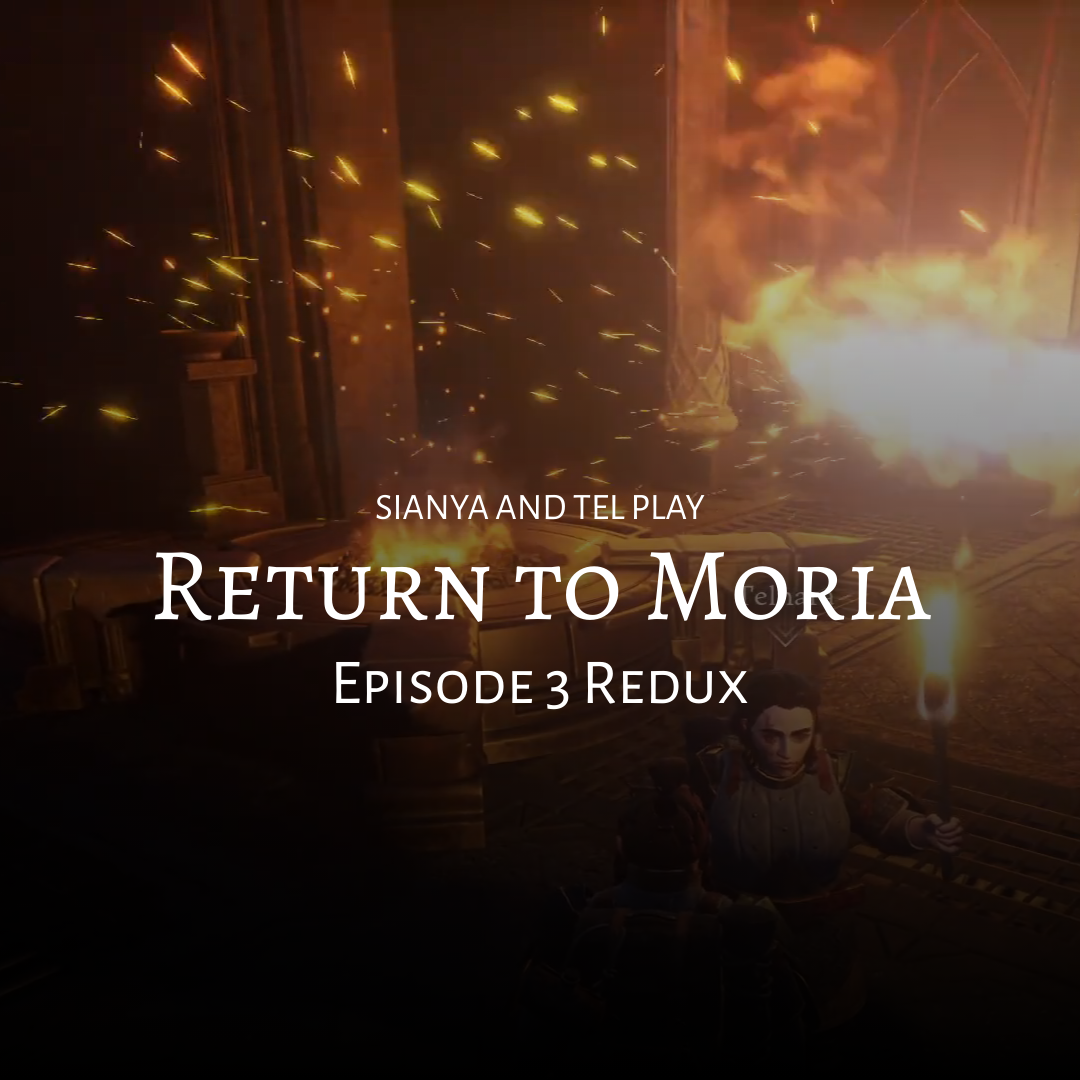
The Return to Moria EP3 – The Second Descent originally streamed on 10th March 2026 – it was birthday dwarfing, chest-sorting, steam-vent death, a black diamond miracle, and the exact moment Moria stopped feeling like a cave system and started feeling like a labyrinth.
We began this stream with the sort of organised survival energy that sounds extremely sensible in theory.
Food first.
Storage second.
Resources third.
Then a proper push deeper into the mines.
Naturally, this turned into birthday Pringles, lemon drizzle cake, a backwards chest, missing tools, light bear-related panic, Tel trying to stop me from aggroing absolutely everything in sight, and one of the prettiest areas we’ve seen in the game so far.
Which, honestly, feels like a perfectly respectable way to spend a birthday in Moria.
“We need to eat first.”
That really was the tone of the afternoon.
Not glory.
Not destiny.
Not heroism.
Just mushrooms.
And for once, that felt entirely correct.
A special day in the mines
The stream opened with us actually inside the Mines of Moria, which already felt like progress given how much time this game can consume with entrances, exits, getting sidetracked, and accidentally developing hobbies you were never meant to have.
The plan, as Tel laid it out, was very practical. We needed to gather resources, establish the new base properly, and stop living quite so much like two dwarves who had been flung into the dark with pockets full of cabbages and vague intentions.
“We’re having mushrooms… as soon as I build a table.”
There is something very funny about survival games when they briefly turn into domestic administration simulators.
Chest placement.
Food logistics.
Scrap management.
Tool confusion.
General muttering.
And then, very casually, the stream revealed its festive subplot.
“It is happy birthday.”
“Thank you.”
“It is a special birthday today.”
“I have left my twenties.”
“That makes me a dinosaur.”
A perfectly normal exchange, naturally improved by the fact it took place while preparing dwarven breakfast and trying to work out what, exactly, had happened to my inventory.
Birthday glamour, but underground.
The highly refined birthday menu
I asked Tel, at one point, what she’d had for breakfast.
The answer was not noble.
It was not balanced.
It was not the sort of answer a nutritionist would embroider onto a cushion.
“Pringles.”
“Cheese and onion flavoured Pringles. Tea and lemon drizzle cake.”
And frankly, if you cannot have Pringles and lemon cheesecake on your birthday while roaming Khazad-dûm in search of resources, when can you?
Later there was also mention of red velvet cake, which gave the whole stream the energy of a dwarven expedition sponsored by increasingly chaotic dessert decisions.
The base-building phase: chest drama, missing gear, and practical dwarven nonsense
Before we could head further into the deeps, we had to sort ourselves out.
This involved:
- emptying bags
- building chests
- deciding what to carry and what to leave
- trying to avoid taking half the mountain with us
- discovering, several times, that I was holding the wrong tool for the job
At one point I built a chest.
Tel immediately noticed a problem.
“You put the chest backwards.”
“Well, I’m a genius, clearly.”
That tiny exchange is very much the spirit of this series.
We are surviving.
We are adapting.
We are also, occasionally, furnishing the apocalypse incorrectly.
There was also the increasingly recurring mystery of my disappearing equipment.
“What happened to my pickaxe?”
“I don’t know.”
“I lost it.”
This was followed, later, by an even more damning discovery.
“Why do you have an old pickaxe on you?”
“I don’t know.”
Somewhere beneath all of this is a deeply serious survival strategy. It is just slightly obscured by me wandering around Moria like a distracted badger in armour.
Tel, mushrooms, and my increasingly obvious resource problem
One of the running jokes of this stream was that I cannot seem to pass a resource without wanting it immediately.
Mushrooms? Mine.
Cabbages? Mine.
Crab apples? Mysteriously also mine.
Random useful-looking objects on the ground? Mine until proven otherwise.
Tel, understandably, had notes.
“You’ve hunted enough for them. I’m surprised they’re not bloody extinct at this point.”
I would like it noted for the record that I was simply being diligent.
Moria is full of useful things.
I am a woman of deep curiosity.
The goblins, bears, wolves, mushrooms, and farming pots should all understand that.
Into the deeps
Once we’d eaten, slept, sorted, repaired, and generally faffed about in a dwarvenly responsible manner, we finally set off properly.
This was the part of the episode where the game began to feel bigger.
Not just more dangerous.
Not just darker.
Bigger.
The earlier areas have a certain rhythm to them after a while. You begin to understand the spaces, the routes, the loops. EP3 was where that certainty started to dissolve.
There were new routes.
New chambers.
New resource seams.
New statues.
New hazards.
More signs that Moria was expanding sideways and downward into something much less manageable.
And Tel, unlike me, was trying very hard to keep the expedition focused.
“I just want to get us somewhere safe first.”
A very sensible position.
One I respected in theory.
Steam vents remain agents of chaos
At one point, things went sharply wrong in a way that felt both dramatic and embarrassingly avoidable.
A steam vent got involved.
Tel got stuck.
And suddenly she was horizontal.
“Revive me.”
“You died real quick.”
There is no kinder, softer phrasing for that. She did die real quick.
It was one of those delightfully rude survival-game moments where the environment reminds you that it is perfectly capable of finishing the job even if the enemies have taken the afternoon off.
Steam vents, it turns out, are not decorative.
The rune table and the first little thrill of progression
Back at base, or at least during one of our many returns to it, we also had one of those progression moments that genuinely feels good in a survival game.
The rune table.
This gave us the ability to improve weapons, including turning my sword into something much more interesting.
“It will do bonus damage and glow when they are near.”
“That’s a bit exciting.”
It really was.
There is something deliciously satisfying about a game giving you a weapon upgrade that feels both practical and theatrical. Not just stronger, but moodier. Slightly ominous. A blade with opinions.
Exactly what you want in a dwarf mine full of increasingly cheeky orcs.
Orc Town, which I did not approach with nearly enough fear
One of the major discoveries of the stream was what Tel immediately identified as Orc Town.
This was, by any reasonable measure, a warning.
A name like Orc Town is not subtle.
It is not coy.
It is not inviting you in for tea.
And yet there I was.
“This is Orc Town.”
“Are you scared? You seem somewhat terrified.”
Terrified might be too strong a word.
Curious, perhaps.
Optimistic.
Prepared to make bad choices for the sake of content.
We did go in.
We did fight.
And the game very quickly made it clear that, although we were doing our best, Orc Town was not currently built around our comfort.
“Your armour is gone.”
“My sword’s dead too.”
A humbling moment.
Not our finest military campaign, but a useful one. EP3 makes it very clear that progression in Return to Moria is not just about courage. It’s about accepting when an area is politely, or not so politely, telling you to come back later with better kit.
The Crystal Depths and the first proper gasp of wonder
And then came the most beautiful discovery of the episode.
The Crystal Depths.
After so much darkness, rough stone, torchlight, hostile corners, and practical scavenging, the reveal of that area felt almost dreamlike.
“Oh no. Oh no. Oh no. I know what gears mean.”
“Oh, how beautiful.”
“So, this is the crystal depths.”
“Wow, isn’t it pretty?”
It really was gorgeous.
This is the point in the episode where we shift slightly from chaos recap into genuine awe. Because that area does something important. It reminds you that Moria is not just dangerous. It is ancient, layered, strange, and at times almost mythic.
The mines stopped feeling like a series of corridors there.
They started feeling like a world.
Fast travel, finally, and the black diamond miracle
The Crystal Depths also gave us one of the biggest practical wins of the stream.
A map stone.
“I have a map stone. Does that mean fast travel?”
Yes. Eventually.
Not in a free, generous, life-is-easy sort of way, obviously. This is still Return to Moria, where every convenience has to be dragged into existence with labour, grit, and at least one rare resource.
But it was still exciting.
And then, later, after more fighting, more exploring, and more of Tel trying to keep me from wandering into danger for the sparkle of materials, we got the real prize.
“We got a black diamond, baby.”
That was the moment.
That was the little treasure-chime inside the episode. The point where all the rummaging around in the dark suddenly turned into actual advancement.
And even better, there turned out to be two.
Which felt, frankly, extravagant.
The horde, at last
We also had a proper horde moment this episode.
Not the end-of-the-world kind.
Not the kind where everything collapses and two dwarves become a cautionary tale.
But a real one.
This mattered, because by now the game had spent a fair amount of time warning us about noise, pressure, escalation, and the consequences of being too enthusiastic with the pickaxe. EP3 gave us the payoff.
And actually?
We handled it reasonably well.
“That was a horde. It wasn’t great, but it wasn’t horrific.”
That feels like a solid review of many life events, to be honest.
It was messy, but manageable. Which is perhaps the ideal tone for this series. We are rarely elegant. We are frequently under-prepared. But we do, somehow, keep lurching onwards.
The bear situation, which briefly improved everything
One of my favourite moments in the episode was the point at which a bear entered the field of conflict and, instead of immediately ruining our day, started attacking the goblins.
“The bear is attacking the goblins.”
“Perfect.”
A wonderful, concise little survival-game miracle.
For one brief shining moment, the local wildlife became an ally through sheer inconvenience.
And then, naturally, we had to deal with whatever was left afterwards, because Moria does not really do free gifts.
Still. Glorious while it lasted.
Domestic dwarven life, now with hats and ring mail
What makes this episode especially satisfying is that it ends the way it begins.
Not with catastrophe, but with a return home.
We came back with resources, recipes, new knowledge, black diamonds, and a much better sense of the map than we’d had at the start. We also unlocked some very pleasing bits of gear progression.
The miner’s helmet was a particular highlight.
“No one remembers which dwarf first put a candle on their head.”
An extraordinary line, and one that deserves to live forever.
Soon after that came ring mail, shields, bronze, and more practical little systems beginning to click into place. The base started to feel less temporary. Less like a panic room. More like home.
There was even farming.
“I have made us a farm patch.”
“Yay.”
Which may not sound dramatic, but in survival games farming is one of the most psychologically reassuring things you can do. It suggests a future. A routine. A plan beyond immediate disaster.
Even if the immediate disaster is still usually only one badly judged pickaxe swing away.
Lore, letters, and the sense that bigger things are coming
Right near the end, we opened a chest using Lóni’s key and found a letter from King Dáin to Balin.
That was one of those quietly important moments. Not explosive, not loud, but a useful reminder that the game is always layering lore beneath the scavenging and chaos. There is history under all of this. Pride, caution, grief, ambition. Moria is never just a dungeon. It is a place with memory.
And EP3 does a very good job of deepening that feeling.
We didn’t find everything we wanted.
We still haven’t made huge inroads into every objective.
We are clearly not overpowered heroes striding effortlessly through the dark.
But we are getting somewhere.
And more importantly, Moria is starting to open itself up.
Not kindly.
Not conveniently.
But unmistakably.
Final thoughts
EP3 felt like the first time The Second Descent became properly expansive.
EP1 was discovery.
EP2 was survival chaos.
EP3 is where the world unfolds.
We had birthday mushrooms.
We had backwards furniture.
We had steam-vent humiliation.
We had Orc Town, the Crystal Depths, a horde, a black diamond or two, a candle-hat, and enough chest sorting to qualify as a part-time dwarven logistics apprenticeship.
And somewhere in the middle of all that, Return to Moria became even more itself: part survival game, part mine-cart bureaucracy, part accidental comedy, and part unexpectedly beautiful underground adventure.
We will, apparently, be back on Thursday.
Which feels right.
There are still statues to rebuild, routes to map, upgrades to chase, and entirely too many things in the dark waiting to have opinions about us.

Join the Mailing List
If you’d like to follow along as I write, reflect, and occasionally ramble about culture, games, music, and memory, you’re very welcome to join me here.
Emails are infrequent and always written by me.